

Heart Tracker Sofware
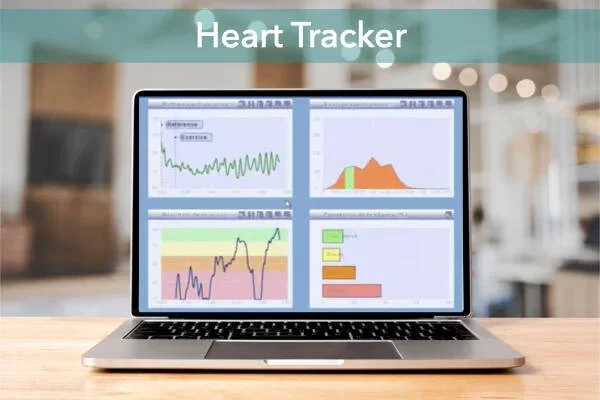
- $295.00 USD — FREE shipping
- Guided HRV Biofeedback Training
- Real-Time Training Score
- Adaptive Difficulty Levels
- Multi-User Support
- Wireless Pulse Sensor
How HRV Biofeedback Works
Using breathing to guide heart rhythm and autonomic balance
HRV biofeedback rests on the natural connection between breathing, heart rate, and the autonomic nervous system. By walking users through paced-breathing exercises, Heart Tracker helps bring these processes into sync and supports a more balanced autonomic state.
- Breathing Shapes Heart Rhythm — Heart rate rises slightly during inhalation and falls during exhalation — a pattern known as respiratory sinus arrhythmia, and the core mechanism behind HRV biofeedback.
- Paced Breathing Strengthens the Effect — Following a guided breathing rhythm lets users amplify these natural fluctuations into a clearer, steadier pattern.
- Reaching Cardio-Respiratory Resonance — At a specific pace — usually 5 to 7 breaths per minute — breathing and cardiovascular rhythms fall into sync, producing one strong, stable oscillation.
- Real-Time Feedback Reinforces the Skill — Heart Tracker tracks these changes as they happen and returns visual and audio feedback, helping users learn to reach and hold this state.
What Is Cardio-Respiratory Resonance?
A physiological marker of efficient autonomic regulation
Cardio-respiratory resonance is the point where breathing, heart rate, and blood pressure rhythms align. It's linked to higher heart rate variability and reflects smoother communication between the sympathetic and parasympathetic branches of the autonomic nervous system.
- Resonance Produces Large HRV Oscillations — At resonance, HRV shows broad, smooth swings driven by the breathing cycle.
- A Sign of Autonomic Balance — This state reflects coordinated autonomic activity and generally points to better physiological regulation.
- The Basis for HRV Biofeedback Training — Training aims to help users reach and hold this resonance state through guided breathing and feedback.
- Tracked in Real Time — Heart Tracker quantifies resonance with a proprietary training score, so users can follow their performance session by session.
Key Benefits
Practical HRV biofeedback for personal use and small practices
Heart Tracker pairs guided breathing with real-time physiological feedback to help users build stronger autonomic regulation, using intuitive visuals and adaptive modes suited to beginners and experienced practitioners alike.
- Builds Autonomic Balance — Paced-breathing exercises encourage cardio-respiratory resonance, a state linked to better autonomic regulation.
- Supports Stress Management — Regular HRV training can strengthen stress resilience and support relaxation programs.
- Adapts to the User — Three training modes let users progress from basic breathing exercises to more demanding resonance work.
- An Engaging Feedback Interface — Graphs, a breathing pacer, and a training score give clear, real-time feedback throughout each session.
- Built for Individual or Small-Practice Use — Multiple user profiles let therapists, coaches, or small clinics run several clients on one system.
Applications
Heart Tracker fits a range of settings where HRV biofeedback supports wellness, stress management, or therapeutic work, including:
- Stress Reduction Training — Guided breathing helps users strengthen their physiological relaxation response.
- Wellness & Self-Regulation — Individuals can use the system independently to build breathing control and autonomic balance.
- Complementary Therapy Support — Practitioners can incorporate HRV biofeedback into treatment plans for stress-related conditions.
- Small-Practice Biofeedback Training — Coaches, therapists, and wellness professionals can train several clients on the same system.
Key Features
Heart Tracker brings together paced-breathing guidance, real-time feedback, and session tracking in one interface.
- Visual & Audio Breathing Pacer — A moving pacer with optional audio cues guides users through paced breathing.
- Real-Time Training Score — A patented algorithm continuously scores cardio-respiratory resonance and cardiac coherence from 0 to 100.
- Four Resonance Zones — Performance is displayed across four zones — low, medium, high, and super — for a quick read on progress.
- Multiple Training Modes — Beginner, intermediate, and expert modes adjust how demanding it is to reach high resonance.
- Real-Time Physiological Displays — Live views of pulse signal quality, heart rate trends, and training score.
- Flexible Session Length — Sessions can be set anywhere from 2 to 20 minutes.
- Customizable Breathing Pacer — Adjust the duration of each phase — inhale, hold, exhale, pause — to match specific goals.
- Audio Reinforcement — Optional tones confirm when the training score enters a target resonance range.
- Audio Suggestive Training Mode — Guided hypno-speech recordings support relaxation and breathing exercises.
- Visual Feedback Mode — A chosen image gradually reveals itself as performance improves.
- Session Recording & Progress Tracking — Every session is saved and can be reviewed later.
Software Interface
Heart Tracker's interface keeps real-time pulse, heart rate, and training data in view alongside the breathing pacer, so users can follow the exercise while monitoring their physiological response throughout the session.
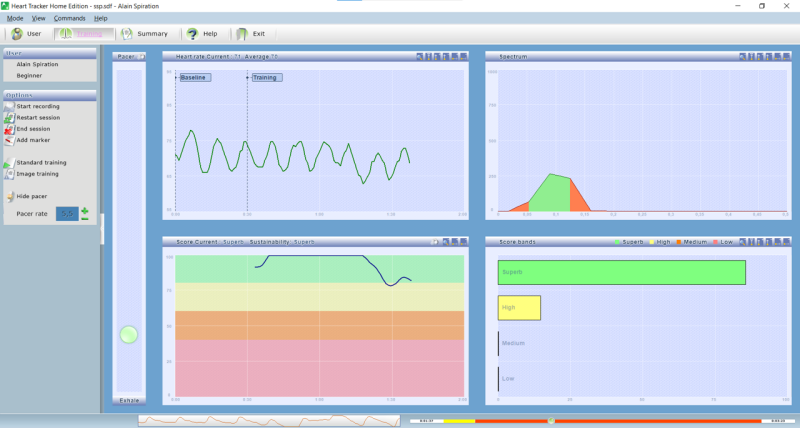
Real-Time HRV Biofeedback Training Screen
The main session screen gives a full view of physiological activity during training: the raw pulse signal, session timeline, and a visual breathing pacer guiding each breath cycle. Synchronized panels show heart rate trends, training score progression across color-coded resonance zones, a 2D HR spectrum, and summary bars showing time spent in each performance range.
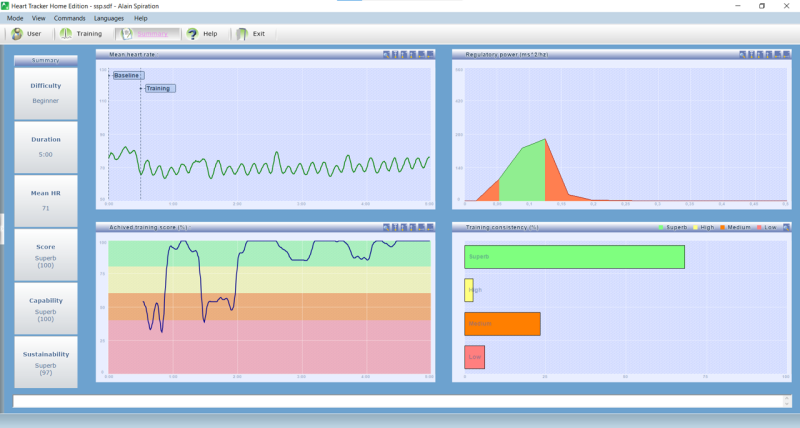
Session Review and Summary Screen
The review screen summarizes a completed session: key numbers on the left, and a multi-panel layout showing heart rate trends, training score progression, spectral data, and performance distribution across the full session.
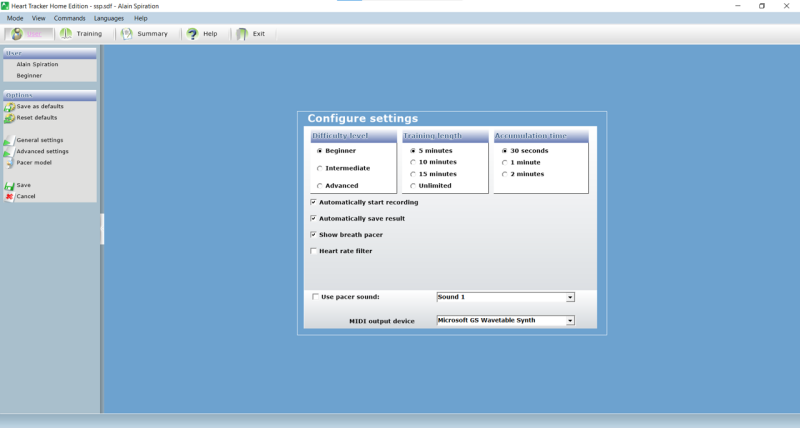
Session Setup and Training Configuration
Before each session, this screen lets users choose the training mode, session length, breathing pacer settings, and feedback options.
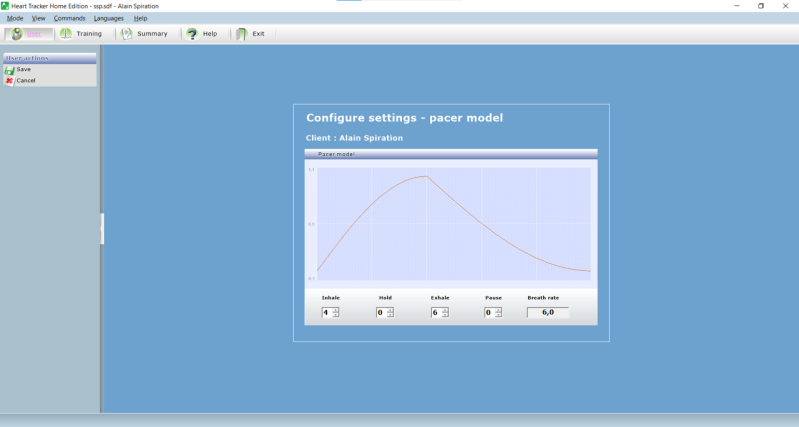
Custom Breathing Pacer Configuration
Users can build a custom breathing pattern by setting the duration of each phase — inhale, post-inhale hold, exhale, and pause — with a graphical display of the resulting breathing waveform.
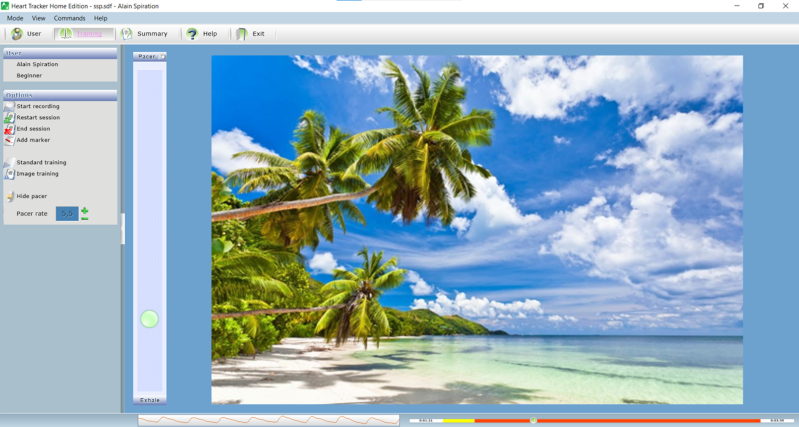
Feedback Image
You can practice on the training screen where you see all four screens simultaneously: the tachogram, the coherence level, the spectrogram, and the percentage of coherence. Or you can set up a feedback image to practice with a photo that reminds you of a pleasant memory, a loved one, etc.; this then becomes emotional coherence. The more coherence you achieve, the clearer the image becomes.

1 . Explain the training goal
Introduce the purpose of HRV biofeedback and how paced breathing helps reach resonance.

2 . Attach the sensor
Place the Biocom 3500 pulse wave sensor on the user's finger to capture pulse wave signals.

3 . Select or create a user profile
Open an existing profile or create a new one to store session results.

4 . Configure training settings
Choose difficulty level, session length, and feedback preferences.

5 . Run the training session
Follow the breathing pacer and watch real-time feedback as the session progresses.

6 . Review the results
After the session, review the training score graph and overall performance
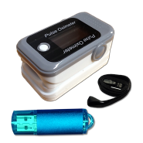
What's Included
Heart Tracker Home Edition ships as a complete, ready-to-use kit for HRV biofeedback training. The package includes the Heart Tracker software along with the wireless pulse sensor and everything needed to start training right away.
Heart Tracker System Components (always included)
- Heart Tracker software (USB flash drive) — The USB drive contains the Heart Tracker installation package for Windows or Mac.
- Printed insert card — Basic product information and getting-started guidance, with references to the full documentation.
- PPG Acquisition Device — Biocom 3500 Bluetooth Pulse Wave Sensor — A compact Bluetooth sensor for convenient finger-based PPG measurement.
Technical Specifications
Heart Tracker Home Edition — Software
- Platform: Windows 10 / 11 or macOS
- Installation media: USB flash drive
- Downloading: Available
- PPG recording: Real-time
- R-peak detection: Real-time algorithm
- R-peak detection editing: Automatic
- HRV analysis: Proprietary cardiac-resonance measurement algorithm
- Visualization: Various real-time / offline graphs and charts
- Biofeedback mode: Visual and auditory
- Reporting: Numerical and graphical session summaries
- Special training mode: Suggestive hypno-speech playback
Computer Requirements
- Operating system: Windows 10 / 11 or macOS
- Processor: Intel i5+ or compatible
- Memory: 8 GB
- Disk storage: At least 2 GB free space
- Wireless interface: Bluetooth LE
Biocom 3500 Sensor
Wireless finger-clip PPG recorder designed for stable pulse signal acquisition.
Trusted HRV Biofeedback Technology
Heart Tracker is grounded in established HRV biofeedback and cardio-respiratory resonance research, combining validated physiological methods with a proprietary algorithm for reliable training feedback.
- Established HRV Biofeedback Methodology — Built on well-recognized techniques that use paced breathing to influence autonomic nervous system activity.
- Cardio-Respiratory Resonance Principle — Training helps users reach resonance between breathing and cardiovascular rhythms — a state linked to higher HRV and better autonomic balance.
- Patented Training Score Algorithm — A proprietary algorithm evaluates resonance amplitude and sustained cardiac coherence, producing a real-time score of physiological performance.
- Real-Time Physiological Feedback — Continuous analysis of pulse signals gives immediate feedback, helping users learn to reach and hold optimal breathing patterns.
- Designed for Consistent Results — Adaptive difficulty and structured feedback support progressive learning and repeatable outcomes.
FAQ
What is Heart Tracker used for?
Heart Tracker is an HRV biofeedback training system that helps users build stress resilience and autonomic balance through guided breathing exercises and real-time physiological feedback.
How does HRV biofeedback training work?
Heart Tracker guides the user through paced breathing while measuring pulse signals. Synchronizing breathing with heart rhythm helps users reach cardio-respiratory resonance, a state linked to improved autonomic regulation.
Who can use Heart Tracker?
Heart Tracker suits both home users and small professional practices — therapists, coaches, and wellness providers offering HRV biofeedback training.
What sensor does Heart Tracker use?
Heart Tracker works with the Biocom 3500 Bluetooth pulse wave sensor, a finger-mounted device that measures pulse signals using optical technology.
Is the sensor difficult to use?
No — the sensor sits on the finger and connects wirelessly to the software, making it simple for everyday use.
How long is a typical training session?
Sessions can run anywhere from 2 to 20 minutes, depending on the user's goals and preferences.
What is the training score?
A real-time indicator of how well the user is reaching cardio-respiratory resonance and sustained cardiac coherence during the session.
Can multiple users share the same system?
Yes — Heart Tracker supports multiple user profiles, so several people can use the same system while keeping their data separate.
Can I review my training progress over time?
Yes — every session is saved, so users can review past sessions and track progress through stored records and reports.
Does Heart Tracker measure blood oxygen (SpO₂)?
The Biocom 3500 sensor supports SpO₂ measurement, but Heart Tracker itself focuses on pulse-based HRV biofeedback and doesn't use this feature.
How soon can I see results from HRV biofeedback training?
Many users notice better relaxation and breathing control within the first few sessions; longer-term gains in stress resilience and autonomic balance typically build with regular training.
Do I need prior experience with HRV or biofeedback?
No — Heart Tracker is built for beginners, with a guided pacer and real-time feedback to help you learn quickly, while advanced settings let experienced users fine-tune their training.
Is HRV biofeedback scientifically supported?
Yes — HRV biofeedback rests on well-established physiological principles, including respiratory sinus arrhythmia and cardio-respiratory resonance, and is widely used in research and clinical settings for stress management and autonomic regulation training.
Downloads
- Product Brochure (PDF)
- Overview of the Heart Tracker Home Edition, key features, and system configuration options.
- User Manual (PDF)
- Detailed instructions for using the software, connecting the sensor, and recording sessions.
- Practical Use Guide (PDF)
- Step-by-step guide to typical HRV biofeedback procedures.
- Software Setup Guide (PDF)
- Instructions for installing and configuring the software.
- Biocom 3500 Device Operation Manual (PDF)
- Detailed documentation for the Biocom 3500 sensor.
Testimonials from our users :
“I had tried other heart coherence tools, but the Heart Tracker is the first one I’ve actually used in sessions with my patients. The simultaneous display of the tachogram and spectrogram allows for an immediate visual explanation, and the interactive feedback image creates a real element of surprise that motivates even the most reluctant people.” — Nathalie B., Private Practice Mental Health Nurse
“What convinced me was the ability to install the software on multiple computers, including my office Mac and my laptop for when I’m out and about. The video tutorial is very well done, and I was up and running in less than an hour. My patients love seeing their coherence curve evolve from one session to the next.” — Sébastien A., Physiotherapist
“As a certified stress management coach, I’ve been using the Heart Tracker for a year as a demonstration tool during my corporate workshops. The coherence ratio—distributed in red, blue, and green—is such a clear visual that even the most skeptical managers immediately understand the value of the practice.” — Laure M., Corporate Stress Management Coach
“The ability to adjust the metronome independently—inhalation time, pauses, exhalation—is a considerable advantage for adapting the protocol to each patient. Some of my elderly patients have a different resonance frequency than the norm, and the software adapts perfectly.” — Dr. Éric F., General Practitioner
“I’ve been teaching sophrology for fifteen years and I’ve integrated the Heart Tracker into my practitioner training. Exporting the data as a file allowed me to create practical exercises with real-world measurements. This is exactly what my students needed to move from theory to practice.” — Martine C., Sophrology Trainer